
Some things are closer to you than your own face, and you have still never seen them.
Here is one. In each of your eyes, right now, there is a hole. Not a tear in the eye itself, but a real gap in the picture it sends, a blind region that can hide something surprisingly large at a distance. You have carried it every waking moment of your life. You are looking through it as you read this sentence.
And you have never once seen it.
That is the strange part. Not that the hole exists. That the picture does not show it.
The Hole in Your Eye
Where is the hole in your eye?
At the back of each eye, the nerve that carries everything you see to the brain has to leave somehow. It exits through a small patch of the retina called the optic disc. To make room for that cable, the patch has no light sensing cells at all. Light lands there and nothing answers.
In the 1660s, a French priest and natural philosopher named Edme Mariotte noticed the gap and found a way to show it to anyone. You can do the same at a kitchen table.
Draw a small cross on a piece of paper. A hand's width to its right, draw a dot the size of a coin. Close your left eye. Hold the paper at arm's length and stare at the cross with your right eye. Do not let your gaze drift. Now bring the paper slowly toward your face.
Somewhere along the way, the dot disappears.
It does not blur. It disappears. And what takes its place is not a dark hole or a smudge. It is clean, blank paper, the same paper that surrounds it. Keep moving and the dot comes back, as if nothing happened.
The first time I tried it, I did it again, and then again, the way you check a lock you already know you closed.
Who Paints Over the Gap
Who paints over the gap?
The retina does not fill the gap. Whatever makes it disappear happens later, in the visual system.
With both eyes open, the seeing region of one eye usually supplies information where the other eye's blind spot falls. But close one, as you just did, and still no hole appears. What you experience instead is the color, the texture, the pattern of the paper simply continuing across the space where no information arrives. Researchers call this filling in, and they still argue about how it works: whether the brain actively builds something to cover the gap, or simply never registers that anything is missing. It happens so smoothly that the hole has no edge, no outline, no sign that anything was ever missing.
Sit with that for a moment. Part of what you call seeing is not seeing. It is a confident, seamless guess, presented to you with exactly the same vividness as the parts that are real.
There is no label in the corner of your vision that says: estimated.
The book carries a line I keep returning to: you are not in the Matrix, you are the Matrix, until you remember you are not. I did not expect to find that sentence quietly at work in the back of my own eye.
How Little Actually Arrives
How much of the world is actually arriving?
The hole is only the beginning.
Hold your thumb out at arm's length and look at the nail. That small patch is roughly the region where your eye sees in sharp detail. Outside it, the retina works in coarser and coarser strokes, with far less color detail than you would guess. Yet the room around you does not feel blurred at the edges. It feels complete, colored and sharp all the way out.
To build that, your eyes jump. Several times a second they flick from point to point, sampling, and during each jump the brain largely turns down what comes in, so you are not dizzied by a smeared world. You do not experience the flicks. You do not experience the gaps between them. You experience a steady, panoramic now.
You may have noticed one seam in it. Glance suddenly at a clock with a second hand, and the first second can seem to hang, longer than the ones that follow. One explanation researchers offer is that the brain backfills the moment of the jump with the image you landed on, stretching it to cover the sliver of time you missed. The effect is well documented. Why it happens is still argued over.
The world you see is not a window. It is a painting, constantly repainted, from a few sharp samples and a great deal of trust.
Turn the Coin
Is the painting a lie or a kindness?
Turn the coin.
One face says: this is a confession hidden in plain sight. If the most trusted sense you own presents guesses as facts, and never tells you which is which, then the feeling of certainty proves very little. Reality as you experience it is already a rendering, built behind your eyes and handed to you finished. The Matrix did not invent that idea. It only dressed it as fiction.
The other face says: the painting is not a deception. It is care. The brain fills the gap with what is almost always there, the paper continuing, the wall continuing, the sky continuing. If it showed you every hole, every jump, and every coarse stroke at the edge, ordinary perception would become unbearably noisy. The guess is faithful because it is built from the world. Filling in is how a limited creature lives gracefully inside a vast one.
Both faces may be true at once. The rendering is real, and the rendering is kind. The question is not whether to trust it. It is whether you remember that it is one.
What Else You Fill In
What else are you filling in?
The Keys do not tell you what is true. They show you the faces. Your task is to feel the coin in your hand.
Once you have watched the dot vanish, it is hard not to wonder where else the same quiet work is happening.
The person you live with, whose silence you have already translated before they say a word. The colleague you decided about years ago, whose every gesture now arrives interpreted. The version of your own past that grows a little smoother every time you retell it. The future you feel sure of, painted in from the edges of what you fear.
None of these feel like guesses. That is the point. A good fill has no edge. It looks exactly like the thing it replaced.
This is part of what the book means by remembering. Not seeing a new world. Noticing the brushstrokes in the one you already have, and loving it anyway, a little more awake.
So here is an experiment to carry into this week. Not with a cross and a dot this time. With a person.
Somewhere in your life is a face you stopped looking at closely, because you already knew what was there. What would you see if you let the dot come back?
If this piece moved something, the beginning of the book is free.
The Keys do not tell you what is true.
They show you the faces.
— Intro to the Keys: The Coin
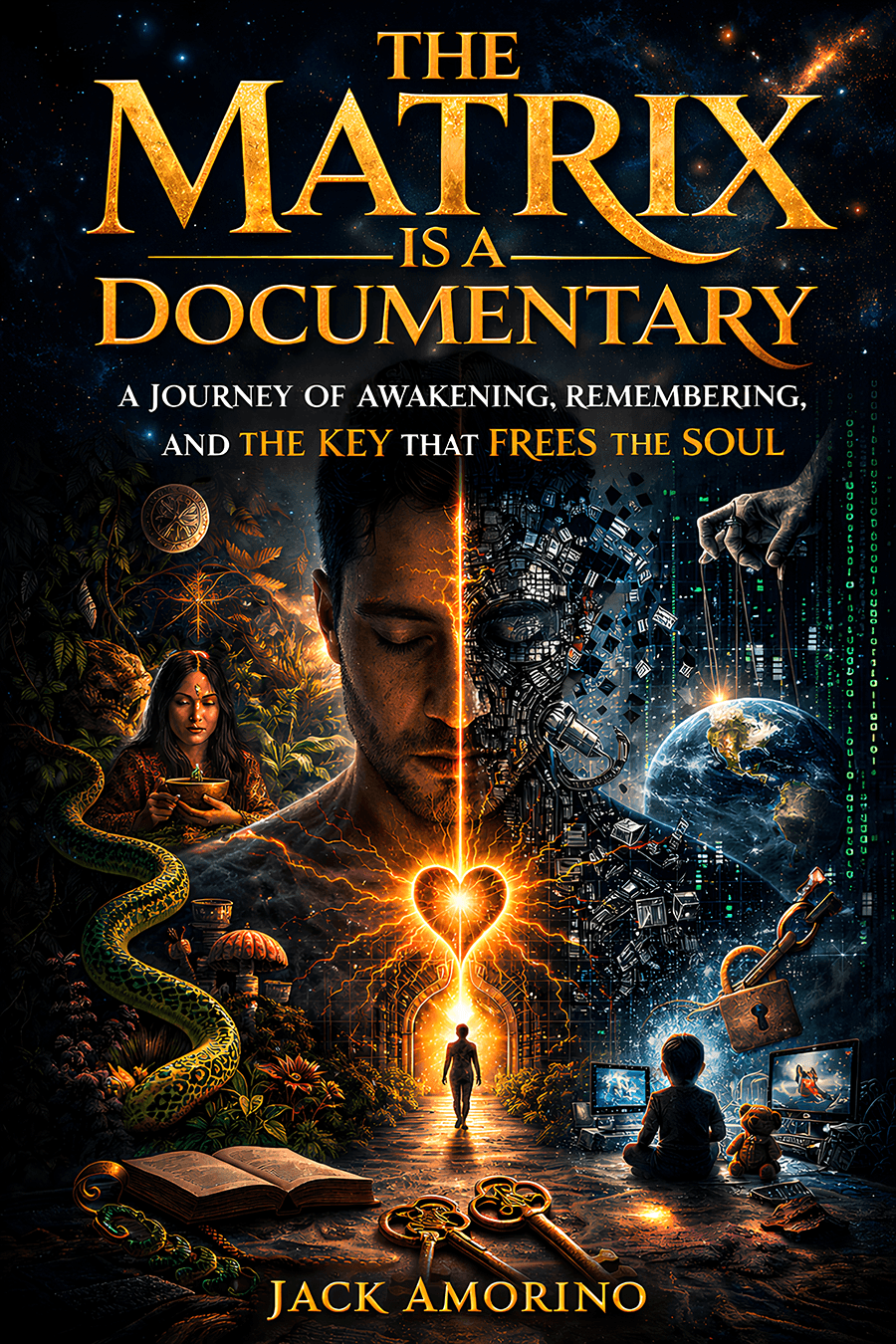
The Keys run deeper in the book: twenty-seven of them, in three Cycles, left behind for those ready to go further.


