
There is a lump of green, corroded bronze in a museum in Athens that does not fit the story we were taught.
Not because it is spooky. Because it is precise.
It is a machine. It once held dozens of gears, with teeth cut so finely you need magnification to count them. It modelled the sky. You turned a handle, and the moon moved through its phases, the sun crept along the zodiac, and small pointers warned you when an eclipse was coming.
It was built more than two thousand years ago.
And then, as far as anything we can hold in our hands is concerned, nothing of its complexity appears again for well over a thousand years.
How does a model of the heavens end up at the bottom of the sea?
In 1900, a crew of Greek sponge divers sheltering from a storm near the small island of Antikythera found a shipwreck. It was full of treasure: bronze and marble statues, glassware, coins. The ship had gone down sometime in the first century BC, heavy with riches from the eastern Mediterranean.
Among the objects brought up were some unremarkable lumps of corroded bronze and wood. They sat in the museum. In 1902, an archaeologist noticed something in one of them: the edge of a gear wheel.
For decades, researchers struggled to understand what they were looking at. The German scholar Albert Rehm had already recognised it as an astronomical calculating device in the early twentieth century, but the surviving fragments resisted any complete explanation.
It took the physicist and historian Derek de Solla Price around twenty years of study, and radiographs of the fragments, to reveal how sophisticated the gearing really was. In the 2000s, a research team used high-resolution CT scans to see inside the corrosion, and found line after line of tiny engraved Greek text, a kind of instruction manual hidden in the metal.
Today it is called the Antikythera mechanism. Some writers call it the first analogue computer.
What did they know that we assume they did not?
Pause on what the machine actually did.
It did not treat the moon as a steady wheel. It modelled a moon that speeds up and slows down along its path. To do that, the makers set two gears on slightly offset axes, joined by a pin sliding in a slot, so that one turned at a changing speed. A theory of the moon that Greek astronomers had worked out with numbers, written in bronze.
It predicted eclipses using a cycle of 223 lunar months. It tracked the four-year rhythm of the great athletic games, the Olympics among them. A 2021 reconstruction by a team at University College London proposed how the missing gears might have displayed all five planets known to the Greeks, circling like a cosmos in a box.
That last part is still a reconstruction, a careful argument from fragments. Much of the machine is missing. But even the surviving pieces are enough to unsettle a comfortable belief.
The comfortable belief goes like this: knowledge climbs. Each age stands on the shoulders of the last and sees a little further. Ancient people were clever, but in a rough, early way. Fine machinery belongs to us.
The bronze in Athens does not quite agree.
Where did the knowing go?
Here is the part I cannot put down.
If a workshop could build this, it is difficult to imagine it was their first attempt at precision gearing. Somebody trained the hands that cut those teeth. Somebody else taught them. There were almost certainly earlier experiments, failed designs, techniques passed from one maker to another. Perhaps there were other machines too.
Almost none of that tradition survives.
We have hints in the texts. The Roman writer Cicero describes a bronze sphere attributed to Archimedes, carried to Rome after the fall of Syracuse, that showed the motions of the sun, the moon and the planets. He mentions another made by the philosopher Posidonius. Centuries later, scholars in the Islamic world described geared calendars, and a few simpler geared objects survive from those later centuries. Then, in fourteenth century Europe, the great astronomical clocks begin to rise in cathedral towers.
But nothing from that ancient tradition survives with comparable mechanical complexity. Only one shipwrecked masterpiece, and a long quiet around it.
Is a lost machine an accident, or a forgetting?
Turn the coin.
One face: this is the ordinary sadness of history. Bronze is valuable. When a machine broke or fell out of use, it was melted down into something else: coins, pots, blades. Workshops closed, wars came, the few people who knew how did not pass it on. Perhaps the only reason we have this one is that the sea took it before anyone could melt it. There is nothing hidden here, only how fragile a skill is when it lives in a few pairs of hands.
The other face: if a civilization can build a working model of the heavens, and nothing comparable survives for more than a millennium, then perhaps the line of progress we were taught is not a line. It is closer to a tide. Knowledge arrives, recedes, and sometimes arrives again. And the people living through the low tide may not know they are living through one. They may look at the ruins around them and decide the builders were primitive, because that is easier than admitting something was forgotten.
You do not have to choose a face. Both may be true at once. Perhaps every great forgetting is made of ordinary accidents, piled high enough that from a distance they look like a wall.
What have you forgotten that you once knew how to build?
The Keys do not tell you what is true. They hand you the coin and ask you to feel its weight.
I think about that bronze lump in a personal way. There was a time when I knew things I could not have explained. As a child I asked questions that made the adults in the room shift in their chairs. Then I grew up, got busy, learned to be practical. The gears were still in me somewhere. They had just corroded, sitting in a drawer, waiting for someone to notice the edge of a wheel.
This is part of what the book means by remembering. Not acquiring something new, but noticing what was already built under the corrosion, and asking what it was made to do.
Maybe the most ancient thing about us is not what we lack. Maybe it is what we have misplaced.
So here is a question to carry into this week, into the drawer you have not opened in years:
What did you once know how to do, so naturally that you never wrote it down, and have since filed under impossible?
If this piece moved something, the beginning of the book is free.
The Keys do not tell you what is true.
They show you the faces.
— Intro to the Keys: The Coin
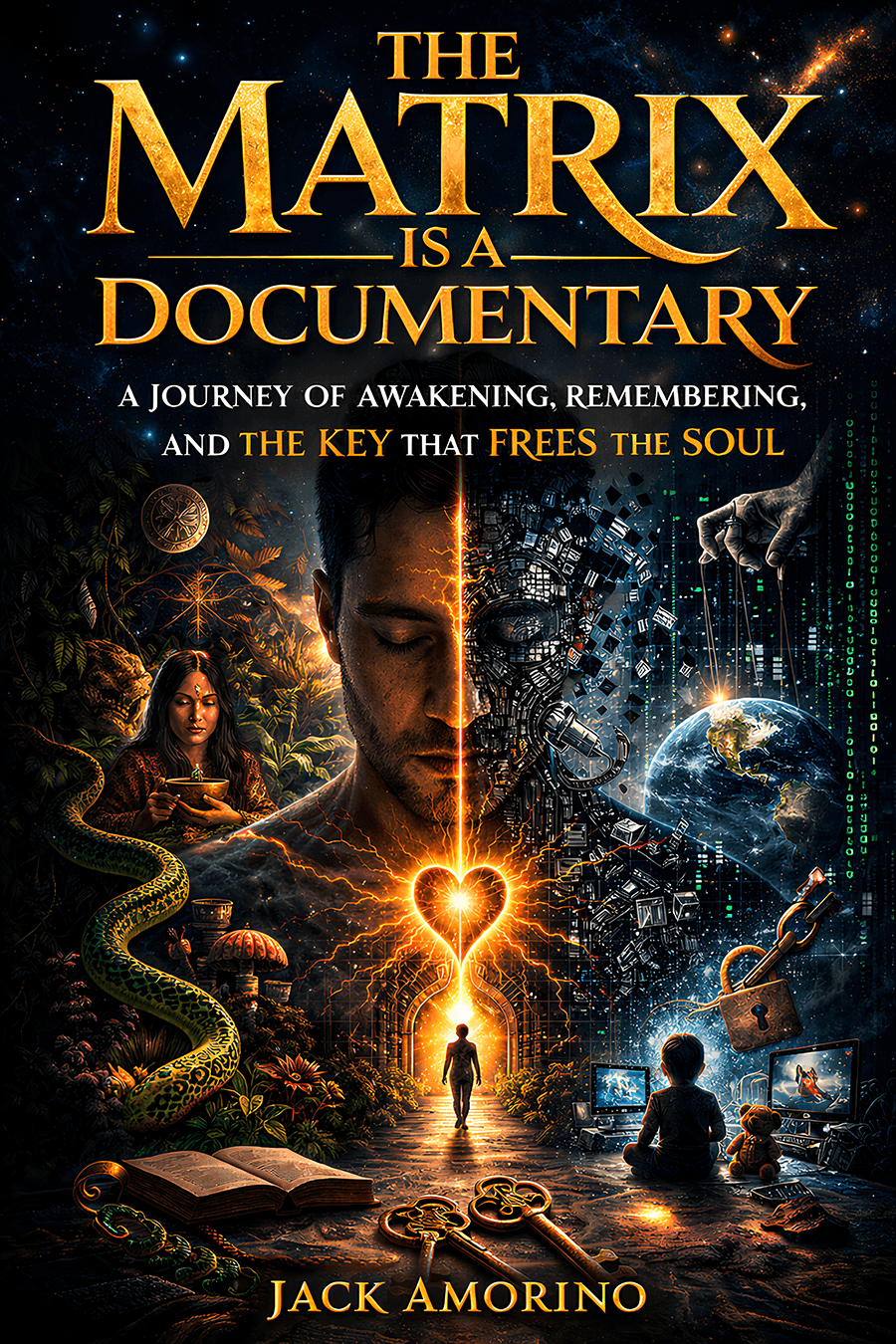
The Keys run deeper in the book: twenty-seven of them, in three Cycles, left behind for those ready to go further.


