
The Maya wrote.
They kept records on folded bark paper, coated with lime and painted in colour, held in cities that tracked the movements of Venus across centuries with an accuracy that still makes astronomers quiet.
Of that entire pre-Conquest tradition of painted books, four codices survive.
Not four libraries. Four books. Three of them have been accepted for generations, named for Dresden, Madrid and Paris, the European cities where they came to rest, rather than for the people who made them. A fourth, the Grolier Codex, now called the Maya Codex of Mexico, was disputed for decades and is now widely accepted as genuine. That is the total shelf. It is shorter than the one beside your bed.
We are taught to file this under time. Paper rots. Empires fall. Things get lost.
Some of it was not lost.
Why did a man have to write down what he burned?
In July of 1562, in a town called Maní in the Yucatán, a Franciscan named Diego de Landa gathered the books and the sacred objects of the Maya and destroyed them in a single ceremony.
Then he wrote about it. That is the part that stops you. His own account describes finding a great number of these books, judging their contents to be falsehood and the work of the devil, and burning them, and it records that the people who stood watching felt an extraordinary grief.
He was not confessing. He was reporting. Destroying the books was not a crime he was trying to hide. He recorded what had been done.
Now turn it over.
That same account, by that same man, contains his attempt to write down how Maya glyphs functioned. His notes were confused and in places simply wrong. Four centuries later they became a key. A scholar working from the far margins of the field used de Landa's flawed pages to begin cracking the script, and the Maya can be read today, in part, because the man who burned their books also wrote down fragments of the system he was trying to erase.
Both of those things are on the same page. Somewhere in the hand that erased a people's memory was the thread that let a little of it back.
Was Alexandria one fire, or a long quiet forgetting?
We prefer our losses cinematic. One night, one blaze, one villain with a torch.
Alexandria will not cooperate. What historians can actually reconstruct is not a single catastrophe but a slow one. Fire during Caesar's campaign in the city. Rulers who changed. Funding withdrawn. Scholars expelled or drifting elsewhere. A sister collection destroyed centuries later. The whole thing thinning out across generations until there was not much left to burn. The famous single-arsonist versions are mostly later stories, cleaner and more dramatic than the fragmentary record they replaced.
The unglamorous version is the more frightening one. A library does not usually die by fire. It dies by budget. By neglect. By the quiet collective decision that this particular kind of knowledge is no longer the kind we pay to keep. Nobody has to set anything alight. Everyone simply has to stop caring for one generation.
That question is worth asking of your own century before you ask it of the fourth.
Why does the same thing keep happening to the same kind of book?
Once you start counting, the randomness drains out of it.
China, in the third century before our era. A first emperor is recorded as ordering the histories and philosophies that competed with his own account collected and burned, and the scholars who argued dealt with harshly. Historians still debate the scale. The intent in the record is not really in question.
Nalanda, in northern India. A monastic university that drew students from across Asia for something like seven centuries, sacked near the end of the twelfth. Later accounts say its libraries burned for months. The months may be legend. The silence afterward was not.
Baghdad, 1258. The House of Wisdom, and the line that has followed it ever since: that the river ran black with the ink of books thrown into it. Almost certainly a later telling. It survives because it says a true thing in the wrong genre.
Berlin, May of 1933. A research institute studying sex and gender, its archive carried into the street by students and burned in one of the most photographed bonfires of the century. Decades of records of real human lives, gone in an evening, in a country famous for keeping excellent files.
Sarajevo, August of 1992. The National and University Library shelled and burning while librarians and citizens tried to save what they could. Aida Buturović, a librarian who had been working to rescue rare books that day, was killed.
Different centuries, different flags, the same instinct. Notice what deliberate destruction so often reaches for. Not only paper, but memory: histories, beliefs, identities, records that preserve an account of the world the destroyer wants replaced.
What if erasure is easier than we let ourselves believe?
The comfortable belief is that truth survives. You cannot kill an idea. Knowledge finds a way. Anything genuinely important would still be here.
It is a beautiful belief. On the evidence, it is mostly untrue.
Whole systems of writing have gone quiet. The knotted cords that carried the records of an Andean empire were condemned as idolatrous and destroyed in numbers nobody can estimate, and what remains could be held in a few rooms, and we still cannot fully read it. Languages have died with their last speaker inside living memory. Most of what human beings have known did not survive, and its absence is invisible, because absence leaves no gap you can see. It leaves a story that sounds complete.
That is the unnerving thing about a well cleaned history. It does not feel edited. It feels finished.
What survives when the libraries do not?
And still.
When armed groups took Timbuktu, the manuscripts began to move, out of the city in trunks and boxes, on carts, hidden in houses, down the river in boats, for months. Hundreds of thousands survived because librarians, families, local communities and preservation networks decided these particular pages were going to outlive this particular week.
Something survives fire that fire cannot reach. Songs carry. Grandmothers carry. A dance, a route, a recipe, a prayer in a language nobody bothers to write down. The Maya did not vanish. Millions of people speak Maya languages today, and their calendar kept turning in kitchens and courtyards while their books were ash.
So feel the weight of the coin.
One face: much of the loss is entropy. Paper decays, libraries burn, empires collapse, languages change, institutions fail. No hidden hand is required to explain why the surviving record is thin and uneven. History is the difficult work of reconstructing a world from whatever evidence happened to remain.
The other face: not everything disappeared by accident. Some of it was chosen. Somebody decided which books were dangerous, which memories were forbidden, which account of a people would no longer be permitted to continue. Sometimes they even filed a report about it and slept soundly that night.
You are not asked to pick a face. You are asked to notice that much of the history you carry arrived with its sources already missing, and to wonder how often you noticed the absence.
The Keys do not tell you what is true. They hand you the coin and ask you to feel its weight.
So here is the question to carry into the next conversation where somebody tells you what your people have always believed:
What was in the books you were not left?
If this piece moved something, the beginning of the book is free.
The Keys do not tell you what is true.
They show you the faces.
— Intro to the Keys: The Coin
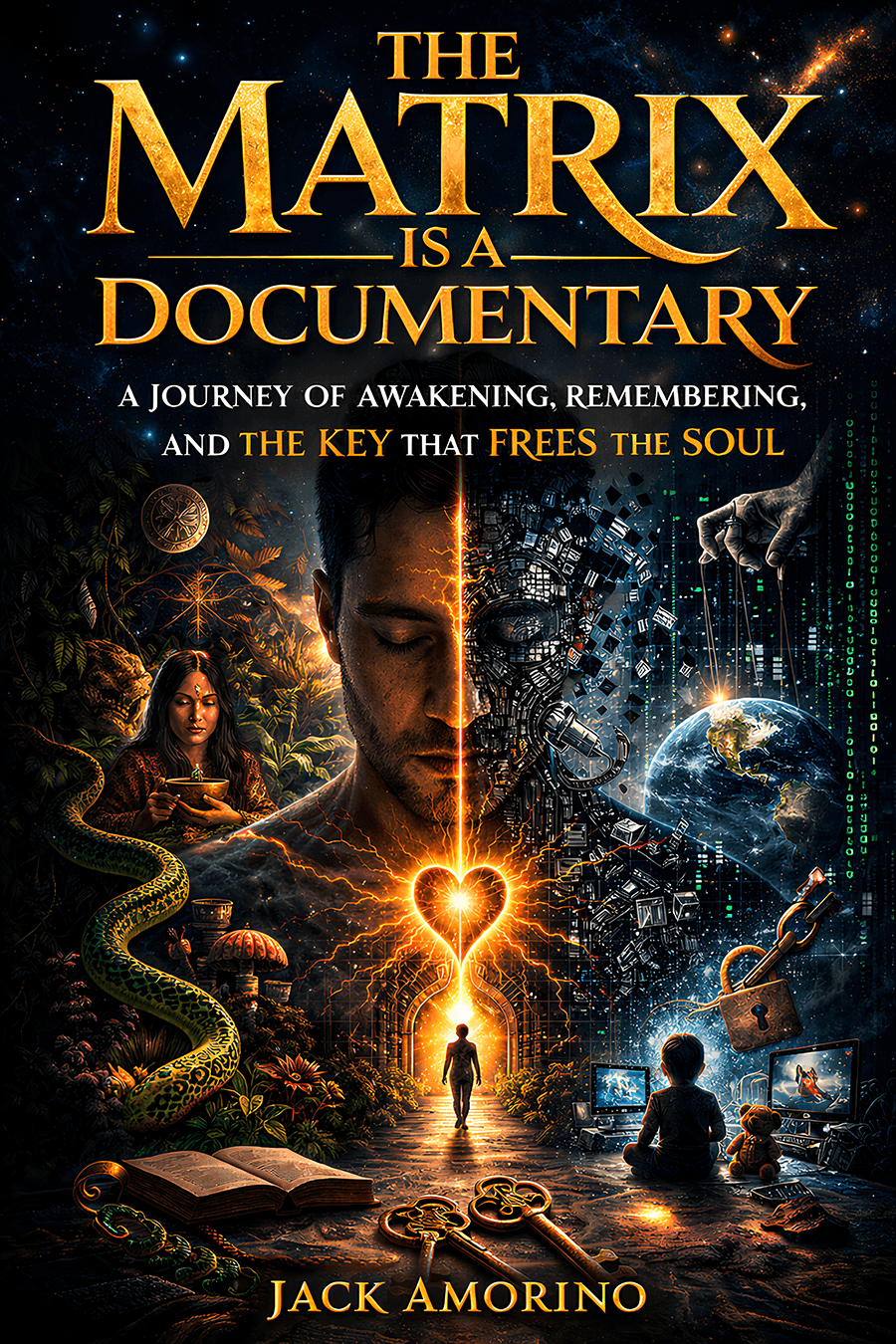
The Keys run deeper in the book: twenty-seven of them, in three Cycles, left behind for those ready to go further.


